At the end of the 18th century and during the first half of the 19th century, Europe underwent a profound cultural transformation driven by Enlightenment ideas, the French Revolution, the rise of nationalism, and the changes brought by industrial societies. In this context, two key artistic movements emerged that marked a turning point in art history: Neoclassicism and Romanticism. Both styles responded—though in opposite ways—to the intellectual, social, and emotional concerns of their time.
🏛 Neoclassicism: The Return to Reason and Antiquity
Historical Context
Neoclassicism emerged in the 18th century as a reaction against the ornamental excess of Rococo and in harmony with the rational ideals of the Enlightenment. Inspired by Greco-Roman antiquity, this movement championed order, harmony, proportion, and balance, promoting a sober and moralizing aesthetic. It coincided with the rise of archaeological studies (such as the discoveries of Pompeii and Herculaneum) and with a critical view of the luxury and frivolity of the ruling classes.
Characteristics of Neoclassicism in Painting
-
Inspiration drawn from classical art: Greek sculpture, Roman reliefs, and ancient architecture.
-
Rational and balanced composition, with clear perspective and symmetry.
-
Restrained colors and precise contours, avoiding theatrical effects.
-
Moralizing or heroic themes: historical, mythological, or patriotic narratives that exalt virtues such as duty, courage, and justice.
-
Strong influence of Enlightenment thought: painting as a vehicle for education and reflection.
Main Exponents of Neoclassicism
🎨 Jacques-Louis David (France)
The leading figure of Neoclassicism. His work symbolizes revolutionary ideals and the return to Roman civic values.
Key works: The Oath of the Horatii, The Death of Marat, Napoleon Crossing the Alps.
🎨 Jean-Auguste-Dominique Ingres
A student of David, he stood out for his meticulous drawing, compositional elegance, and idealized portraits.
Notable works: The Grand Odalisque, Portrait of Madame Moitessier, The Apotheosis of Homer.
🌩 Romanticism: The Exaltation of Emotion and the Sublime
Historical Context
As the 19th century progressed, a reaction against Enlightenment rationalism began to take shape. Romanticism emerged as an affirmation of individual emotion, imagination, nature, and mystery. Rather than following classical models, Romantic artists sought to express their deepest feelings, explore the irrational, and represent the sublime—that which inspires awe, fear, or grandeur.
This movement developed alongside social changes brought about by the Industrial Revolution, the rise of nationalism, and a profound transformation in the concepts of freedom and subjectivity.
Characteristics of Romanticism in Painting
-
Emphasis on emotion and subjectivity: melancholy, passion, drama, fear, longing.
-
Themes related to untamed nature, history, legends, the exotic, and the fantastic.
-
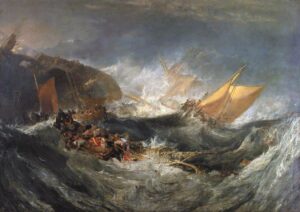
Interest in the sublime: scenes that evoke grandeur or terror (stormy seas, ruins, mountains, disasters).
-
Intense use of color and expressive brushwork, with charged atmospheres and freer compositions.
-
The artist as a solitary genius, in search of inner truth.
Main Exponents of Romanticism
🎨 Francisco de Goya (Spain)
Considered a bridge between Neoclassicism, Romanticism, and modernity. His work evolved from court portraits to dark visions and profound social critique.
Key works: The Third of May 1808, Saturn Devouring His Son, The Nude Maja, Los Caprichos.
🎨 Eugène Delacroix (France)
Master of color and movement, Delacroix portrayed struggle, passion, and exoticism in vibrant canvases.
Notable works: Liberty Leading the People, The Death of Sardanapalus, Women of Algiers.
🎨 Caspar David Friedrich (Germany)
The quintessential Romantic landscape painter. His work combines nature and spirituality with an intense sense of solitude.
Key works: Wanderer Above the Sea of Fog, The Monk by the Sea, The Lonely Tree.
Comparison Between Neoclassicism and Romanticism
| Aspect | Neoclassicism | Romanticism |
|---|---|---|
| Inspiration | Classical Greco-Roman art | Nature, emotion, the irrational |
| Approach | Rational, moralizing, didactic | Subjective, emotional, intuitive |
| Composition | Balanced, symmetrical | Dynamic, free, atmospheric |
| Themes | Ancient history, heroism, civic duty | Freedom, tragedy, nature, the sublime |
| Technique | Precise drawing, restrained color | Loose brushwork, expressive color |
| Role of the artist | Intellectual serving an ideal | Individual genius in conflict with the world |
Neoclassicism and Romanticism represent two opposing poles that illustrate the complexity of art in times of change. The former looks to the classical past in search of order and reason; the latter delves into emotion, mystery, and nature. Together, they form a fascinating stage that anticipates the debates and ruptures that would later lead to modern art.
Both styles continue to exert a strong influence on contemporary visual culture—from historical cinema to conceptual art, literature, architecture, and modern painting. Understanding their principles is essential to understanding art as a reflection—and sometimes a critique—of the human spirit.