Throughout history, painting has proven to be far more than a mere representation of the visual world. From the earliest cave art to digital works created with artificial intelligence, painting has accompanied humanity as a means to narrate, question, evoke emotion, and interpret the world. It is a visual language in constant evolution, capable of adapting to the cultural, political, technological, and social contexts of each era, without losing its expressive power or its ability to move viewers.
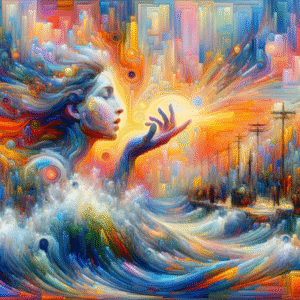
Painting as a Mirror of Humanity
Every stroke, color, and texture across the centuries has captured not only images but also ideologies, beliefs, emotions, and paradigm shifts. From the religious icons of the Middle Ages to the psychological portraits of the Baroque, from the search for light in Impressionism to the conceptual inquiries of contemporary art, painting has reflected human history and its evolving sensitivity.
Moreover, painting has served as a tool for resistance, social critique, and identity assertion across multiple cultures and contexts. It has been religious and political, intimate and monumental, decorative and revolutionary. Its versatility as a medium makes it one of the most enduring and adaptable artistic languages in existence.
Its Role in Contemporary Visual Culture
In today’s world, marked by an overabundance of images and an immediate digital culture, painting continues to occupy a central place. While often regarded as a traditional or “classical” discipline, contemporary painting is far from static or outdated. On the contrary, it engages with current media, reflects on contemporary issues, and constantly reinvents itself.
Contemporary painters address topics such as gender identity, historical memory, ecological crises, artificial intelligence, and migration, using both traditional techniques and hybrid languages. Painting today coexists and intertwines with design, photography, urban art, animation, augmented reality, and other forms of visual expression, demonstrating its ability to adapt without losing depth.
Additionally, painting has found new channels for dissemination, commercialization, and audience engagement through social media, digital platforms, and virtual spaces.
The Relevance of Painting in the Technological Age
In the digital era, many might think painting is being eclipsed by “more modern” technological media. Yet the opposite is true: painting not only endures but transforms and evolves. Digital tools do not replace traditional painting—they expand its expressive possibilities.
Nowadays, artists paint directly on graphic tablets, create works for virtual exhibitions, or integrate painting with artificial intelligence, animation, and augmented reality. At the same time, painting on canvas, paper, or walls remains a deeply human, physical, and reflective practice, offering a tactile and meditative experience that cannot easily be replaced.
NFTs (non-fungible tokens), for example, have opened new ways to circulate and value digital painting, creating a global market and new forms of authorship. Across all formats, painting continues to be a powerful channel to express ideas, emotions, and personal or collective narratives with the same intensity as thousands of years ago.
An Art Form That Is Always Alive
Painting is and will continue to be a relevant art form—not merely by tradition, but through its capacity for renewal, expressive richness, and direct connection to human experience. It does not matter whether it is created with mineral pigments on a cave wall, oils on canvas, spray paint on an urban wall, or pixels on a screen: painting lives wherever hands wish to communicate with color and form.
It is a timeless, borderless, and limitless language.
Its history is neither linear nor closed: it is a spiral that expands, revisiting the past while looking toward the future. Today more than ever, painting invites us to observe, imagine, reflect, and actively participate in the construction of collective imagination. For this reason, in education, culture, art, and everyday life, painting remains essential.