A Technical, Aesthetic, and Humanist Revolution
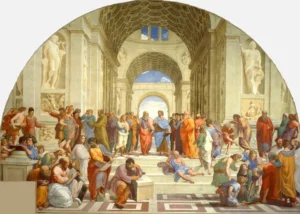
The Renaissance was one of the most significant periods in the history of Western art. Emerging in Italy between the 14th and 16th centuries, it marked the transition from the Middle Ages to the modern world. This era was characterized by a profound revival of classical thought, a renewed appreciation of the human being, and a radical shift in how reality was conceived and represented in art.
In painting, the Renaissance brought about a true revolution—both technical and conceptual. Artists moved away from the rigid, symbolic schemes of medieval art and developed a new way of viewing the world: more rational, harmonious, naturalistic, and centered on the individual.
A Technical and Conceptual Revolution
Renaissance artists not only innovated with new materials and techniques; they also profoundly transformed the very notion of art as a means to understand, explore, and represent the visible world.
🎯 Linear Perspective
One of the most emblematic advances of the Renaissance was the development of linear or mathematical perspective. This technique made it possible to represent depth and three-dimensional space on a flat surface, giving compositions a realistic and coherent sense of space.
-
Introduced by artists such as Filippo Brunelleschi and theorized by Leon Battista Alberti.
-
Allowed figures, architecture, and landscapes to be placed within more natural and rational scenes.
🧠 Study of the Human Body
Anatomy became a fundamental field of study. Artists examined the human body with scientific precision, conducting dissections and detailed observations to improve their representations.
-
Human figures became more proportionate, dynamic, and expressive.
-
Beauty was understood as mathematical and natural harmony.
🌗 Chiaroscuro
The use of chiaroscuro (the contrast between light and shadow) made it possible to create realistic volumes and atmospheres, giving paintings both emotional and physical depth.
-
Perfected by masters such as Leonardo da Vinci.
-
Added drama, realism, and a poetic dimension to scenes.
Great Masters of the Renaissance
🧠 Leonardo da Vinci (1452–1519)
A universal figure of the Renaissance—painter, scientist, inventor, and humanist. His works combine art and knowledge in perfect harmony.
-
Key works: The Last Supper, Mona Lisa, The Virgin of the Rocks.
-
Innovations: anatomical studies, sfumato (soft transitions), and the pursuit of ideal and spiritual beauty.
🛠 Michelangelo Buonarroti (1475–1564)
Painter, sculptor, and architect. His painting conveys strength, drama, and spirituality.
-
Masterpiece: the frescoes of the Sistine Chapel, especially The Creation of Adam and The Last Judgment.
-
His representation of the human body expresses divine and heroic energy.
🎨 Raphael Sanzio (1483–1520)
Renowned for balance, grace, and formal perfection. Raphael synthesized the compositional clarity of antiquity with the delicacy of the Renaissance ideal.
-
Key works: The School of Athens, The Sistine Madonna, the Vatican frescoes.
-
A leading figure of harmonious classicism and idealized religious painting.
Humanism and the Rediscovery of Classical Antiquity
Renaissance art was deeply influenced by humanism—an intellectual movement that placed the human being at the center of the universe. Inspired by the ideals of ancient Greece and Rome, humanism promoted the study of nature, philosophy, literature, science, and classical art.
-
Artists sought to imitate and surpass the classics in balance, proportion, and beauty.
-
Art became a form of knowledge, a way to explore the world and express individuality.
-
The medieval theocentric view was replaced by an anthropocentric perspective: humanity as the measure of all things.
The Legacy of the Renaissance in Painting
The Renaissance not only marked a brilliant chapter in European art but also laid the foundations of modern Western art. Its innovations in perspective, anatomy, composition, light, and color continue to be studied and admired today.
Moreover, the Renaissance elevated the artist from the status of craftsman to that of intellectual and creator, paving the way for a new understanding of art as a discipline closely linked to science, philosophy, and spirituality.