The Visual Language of the Great Empires
After the first prehistoric cave markings, painting evolved alongside the development of the earliest great civilizations. From Egypt to Mesopotamia, and from Greece and Rome to China and the pre-Columbian cultures, ancient painting became a powerful tool for conveying ideas, reinforcing beliefs, decorating sacred and secular spaces, and preserving the memory of the powerful. These civilizations not only refined pictorial techniques, but also endowed their works with deep symbolism that continues to amaze us today for its richness and diversity.
Function and Meaning of Ancient Painting
In ancient civilizations, painting was not merely visual decoration: it fulfilled religious, political, social, and symbolic functions. It served to narrate mythical stories, represent gods, legitimize the power of rulers, celebrate conquests, honor the dead, or decorate temples and palaces.
In many cultures, painting was understood as a bridge between the earthly and the spiritual world, or as a way to ensure the immortality of those depicted. The image was not just a representation, but a manifestation of being.
Major Civilizations and Their Pictorial Legacy
🏺 Egypt: Art for Eternity
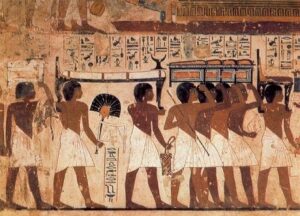
In Ancient Egypt, painting played a fundamental role in tombs, temples, and sarcophagi. Flat colors, defined outlines, and strict symbolic codification were used. Figures were represented in a frontal and hierarchical style: size indicated the importance of the character.
The most common themes were scenes of the Afterlife, offerings, deities, pharaohs, and everyday life. Colors also had symbolic value: blue and green were associated with fertility and life, while red and yellow represented power or the divine.
🏛 Mesopotamia: Art as a Chronicle of Power
Although fewer pictorial examples have survived than in Egypt, in Mesopotamia (Sumeria, Babylonia, Assyria) painting decorated temples and palaces, with narrative frescoes and murals depicting religious ceremonies, scenes of war, and royal authority. Intense colors and geometric forms were also used.
🏛 Greece: Ideal Beauty and Visual Narrative
Greek painting, though less well preserved than its sculpture and architecture, reached a very high level in pottery and frescoes. Painted ceramics are a key source for understanding daily life, mythology, and Greek thought.
Styles such as black-figure and red-figure painting on clay backgrounds were developed. Greek painters also explored perspective, volume, and emotional expression, seeking to represent the idealized beauty of the human body and heroic scenes.
🏛 Rome: Realism and Decoration
Roman painting, heavily influenced by Greek art, stood out for the mural frescoes found in villas and cities such as Pompeii and Herculaneum.
Decorative styles such as trompe-l’œil (optical illusions) and architectural landscapes were developed. Themes included mythological scenes, realistic portraits, still lifes, and everyday life. Painting was an expression of social status and cultural refinement.
🏯 China: Painting as Philosophy
From an early period, painting in China became one of the most highly valued arts, closely linked to calligraphy and spirituality.
During the Han dynasty and later periods, landscape painting (shanshui) was consolidated—not merely representing nature, but expressing harmony between human beings and the cosmos. Fine brushes, ink, and silk or rice paper were used. Subjects also included animals, flowers, and scenes of wisdom or introspection.
🗿 Pre-Columbian Civilizations: Color and Cosmology
In Mesoamerica and the Andes, cultures such as the Maya, Aztec, and Inca developed pictorial systems rich in symbolism.
The Maya, for example, painted codices, murals, and ceramics with mythological, ritual, and dynastic scenes, using intense colors and geometric stylization. The Aztecs combined pictography and painting to convey religious and political information.
In the Andes, decorated walls and textiles also served ritual or power-related functions, with patterns and colors full of meaning.
Techniques and Materials Used
Ancient civilizations employed a wide variety of techniques and materials depending on their environment and resources:
-
Frescoes: Painting on wet plaster (as in Rome and Crete).
-
Tempera: Pigments mixed with binders such as egg white or gum (widely used in Egypt and Greece).
-
Ink and brush: Fundamental in China and other Asian cultures.
-
Natural pigments: Earth, minerals, oxides, charcoal, lapis lazuli, malachite, among others.
The use of color was not random, but symbolic and culturally coded.
The Legacy of Ancient Painting
The painting of ancient civilizations laid the foundations of both Western and Eastern art. Many aesthetic principles, techniques, and symbols were later recovered, reinterpreted, or idealized in periods such as the Renaissance or Neoclassicism.
Moreover, these examples of millennia-old art continue to inspire contemporary artists and spark admiration for their beauty, mystery, and technical precision. Today, many of these works are studied, restored, and protected as part of humanity’s cultural heritage.
A Living Heritage
Painting in ancient civilizations does not only decorate museums: it is part of humanity’s collective memory. It speaks to us of the values, beliefs, and dreams of the first great peoples in history.
Exploring their pictorial art is a journey through time and a recognition that, for thousands of years, human beings have sought to give visual form to what they feel, fear, believe, and desire.